A Glimpse into India’s Connected Future with V2X and Smart Infrastructure
In the hustle and bustle of modern city life, where daily commutes are often synonymous with gridlocked roads
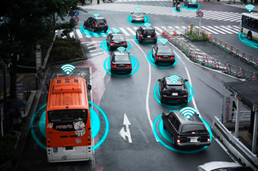
In the hustle and bustle of modern city life, where daily commutes are often synonymous with gridlocked roads, accidents and parking nightmares, envision a future where such challenges fade away. It is a reality on the horizon as these technologies are actively in development, with anticipated rollouts expected by 2030. Thanks to the transformative potential of Smart Infrastructure and Connected Vehicles (V2X), transformative technology is enabling seamless communication among vehicles, infrastructure, pedestrians and smartdevices, revolutionising transportation dynamics. Join us as we delve into the promising landscape of V2X and see how AIC T-Hub, India’s innovation powerhouse, is spearheading the charge towards a connected urban future.
AIC T-Hub, the Accelerator for Commercialisation of Innovation at T-Hub, is nestled at the heart of India’s smart mobility ecosystem. AIC T-Hub plays a pivotal role in fostering and advancing cutting-edge solutions. It provides a dynamic platform, acting as a catalyst for both startups and established companies to develop and test V2X solutions, hereby nurturing a culture of innovation.
Traffic congestion in India results in staggering costs annually. According to the Boston Consulting Group’s report, (BCG) congestion in just four Indian cities is projected to incur costs exceeding USD 22 billion, and it has long been a bottleneck to productivity and a thief of precious time. However, emerging technologies like V2X offer some hope. By acilitating real-time communication between vehicles and infrastructure, V2X promises to revolutionise urban mobility.
Vehicles can communicate wirelessly with each other by using V2X technology. They can also communicate with infrastructure, such as traffic lights and road signs, fostering real-time information exchange. This communication facilitates dynamic traffic signal timing, reducing wait times by up to 25 per cent, improving traffic congestion management and promoting smoother traffic flow.
According to a report by the National Highway Traffic Safety Administration (NHTSA) in the United States, V2V technology can reduce 80 per cent of non-impaired crashes. Studies have highlighted the substantial benefits that V2X implementation can bring to urban environments:
● Reduced traffic accidents by 13 per cent
● Reduced travel time by 15 per cent
● Decreased fuel consumption and CO 2 emissions by approximately 10 per cent
● Enhanced road safety
● Improved traffic efficiency
● Improved air quality due to reduced emissions
● Boosted the economy through time saved during travel
Consumer attitudes towards vehicle ownership are undergoing a significant shift, especially
in urban areas offering diverse mobility options. According to KPMGs 2019 Global
Automotive Executive Survey, 39 per cent of the respondents foresee a decline in vehicle ownership, with half of the current car owners anticipating they wont own a personal vehicle by 2025. Data from the UK Department for Transport indicates a notable decrease in the percentage of men with a full driver's license, attributed to changing preferences among younger demographics. The transformation is linked to the rising demand for "mobility-as-a-service" (MaaS), seen in the prevalence of on-demand private car hire services like Uber and Lyft globally. MaaS represents a shift from ownership to service-based transport, encompassing multi-modal transport ggregation and on-demand mobility.
AIC T-Hub's Role in Driving V2X Innovation and Adoption Collaborating with government agencies and research institutions, T-Hub actively contributes to creating a upportive regulatory environment for the seamless integration of V2X technology into urban infrastructure. T-Hub actively engages in educating the public about the numerous benefits of V2X technology, driving widespread adoption. An exemplary initiative under T-Hub's umbrella is the MOVE: Multimodal Mobility Ecosystem program. This collaborative effort unites startups, investors and government agencies to develop and pilot innovative V2X solutions inTelangana.
As of 2023, AIC T-Hub has helped startups raise:
● INR 66.1 million funding raised
● INR 689.19 lakh MRR
● 21.38 customer growth
● 107.6 burn rate
A Multi-Pronged Approach: Indian AIC Network Cultivates Diverse V2X Solutions for Intelligent Mobility
● AIC Vallabhbhai Patel Institute of Information Technology (VP-IIT), Delhi: This AIC is focusing on supporting startups that are developing V2X solutions for intelligent transportation systems.
● AIC Indian Institute of Technology Bombay (IITB), Mumbai: This AIC is supporting startups that are developing V2X solutions for connected vehicles and autonomous driving.
● AIC Nirma University, Ahmedabad. This AIC is supporting startups that are developing V2X solutions for smart cities. T-Hub’s Commitment to V2X Innovation, Collaboration and Policy Advocacy
While V2X implementation is still in its early stages, the undeniable potential for transformative change is on the horizon. As V2X solutions mature and gain wider adoption, cities can expect a dramatic transformation, and T-Hub remains committed to leading this transformation.
T-Hub paves the way for a connected future of urban mobility not only in India but overseas, as well. AIC T-Hub organises hackathons and challenges, sparking collaboration and out-of- the-box thinking in urban mobility solutions. AIC T-Hub actively contributes to shaping a supportive regulatory environment for a smooth integration of V2X technology into urban infrastructure.


.svg)
.svg)


.webp)

.webp)
.svg)
.svg)



.svg)

.svg)

.svg)
.jpg.jpeg)
.svg)
.svg)





.svg)
.svg)
.svg)



.svg)
.svg)